"Over 30% of our country's population are people with mobility impairments. As the aging population continues to grow, this percentage will likely increase. I thought a system to help these individuals was necessary, which is why I started working on wheelchair development four years ago."
Park Dong-hyun, CEO of HYCORE, has a deep interest in technologies that assist people with mobility challenges. There is a personal reason for this. He was a prominent judo athlete until the 10th grade, but one day, he suffered an injury during a match and was diagnosed with a Grade 4 disability. As a result, walking for long periods of time is still a challenge for him.
In 2012, Park established HYCORE and began working on motor synthesis technology and propulsion systems. After years of developing fundamental technologies, he began working on creating electric wheelchairs based on this knowledge.
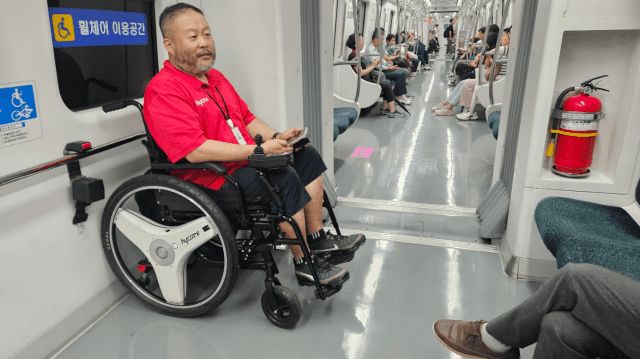
Park Dong-hyun, CEO of HYCORE, seen riding the subway in an electric wheelchair (Photo: HYCORE).
Once the product was developed, the potential for expansion became evident. Based on the self-made hardware, they began incorporating artificial intelligence autonomous driving technology. They formulated a plan to advance the technology and eventually enter the personal mobility market.
Investments from relevant industries followed. HYCORE is collaborating with Hyundai Motor Group on mobility development and has signed a business agreement with Hanjin for the distribution market. Recently, service robot specialist Everybot acquired the company, aiming to diversify its business.
■ "Long-Term Investment in Motor Synthesis and Control Technology"
EO Park outlined three core technologies of HYCORE: synthetic motor control technology, electric drive design and manufacturing, and artificial intelligence-based autonomous driving, explaining that the company holds proprietary intellectual property in these fields.
A synthetic motor refers to combining two or more motors. HYCORE combined two motors—one for power and one for speed—to improve system efficiency, similar to a transmission system.
"When we start, we use the power-type motor. As speed picks up, we gradually start running both motors together. Once the speed reaches its peak, we shut off the power motor and run only the speed motor. This way, the motor gets some rest time, making it easier to manage heat generation."
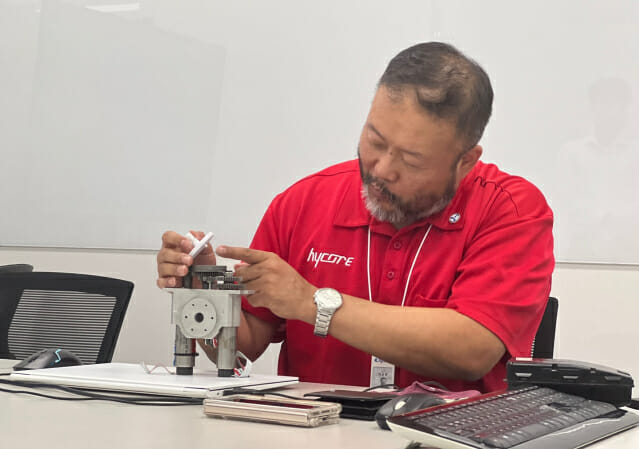
Park Dong-Hyun, CEO of HYCORE, explains the design of the synthetic motor. (Photo: ZDNet Korea, Shin Young-Bin)
Control, as much as the design, was no easy task. He explained that significant investment was needed to develop the electronics technology to precisely control the complex motors.
As a result, the company created a wheel conversion platform with the shape of a wheel. Two of the three spokes are equipped with motors, while the remaining spoke holds a battery to maintain balance. This design allows it to be attached directly to a bicycle or cart for use.
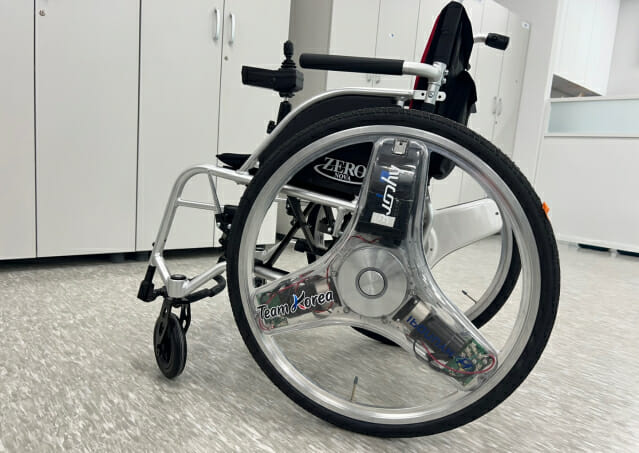
Inside the HYCORE electric wheelchair wheel (Photo: ZDNet Korea, Shin Young-Bin)
■ "From Electric Wheelchairs to Personal Mobility"
HYCORE developed the smart electric wheelchair "AutoWheel" based on its core technologies. The AutoWheel is notable for its significantly reduced weight compared to other products. It also features the ability to fold, rotate in place, and operate autonomously.
When I personally test-drove the product, I was impressed by its smooth steering and speed control. The in-place rotation makes it convenient for boarding and disembarking from elevators. It is also equipped with forward collision prevention and an automatic brake system, which helps prevent falls and accidents.
HYCORE began supplying electric wheelchairs to Bundang Seoul National University Hospital in 2022. Since then, the company has been expanding its product supply by partnering with Hyundai Motor Group, KT SkyLife, and Ottobock.
The company has also been active in supporting disability sports events. In March, they visited the World Wheelchair Curling Championships held in Gangneung to engage with athletes from around the world, and thanks to an invitation from the Korea Paralympic Committee, HYCORE will be showcasing its products at the upcoming Paralympic Games.
CEO Park shared, "The global electric wheelchair market was valued at about 5 trillion KRW last year, with an expected annual growth rate of 11.5%. As the elderly population grows, demand is expected to increase rapidly in South Korea as well."

HYCORE employees are seen using electric wheelchairs to move around the Louvre Museum in Paris, France. (Photo: HYCORE)
■ "We will supply technology that is essential for people"
HYCORE is also researching alternative applications beyond wheelchairs. They have developed cold chain transportation robots and electric towing carts, and have opened up possibilities for expansion into personal mobility. Starting in November, they will launch a demonstration service for people with mobility impairments at airports in collaboration with Hyundai Motor Company and Incheon International Airport Corporation.
There are high expectations for their collaboration with Everybot, which has become an affiliate. Combining HYCORE's core technology with Everybot's expertise in service robot R&D, they aim to accelerate the development of autonomous personal mobility robots.
CEO Park emphasizes that while dreaming of a better future, "technological advancement should begin by solving the problems that are right in front of us."
"You can't look at the distant future if you haven't even solved the problems that individuals need. I want to grow the company into one that can supply technology needed tomorrow or the day after, not just in the far-off future."
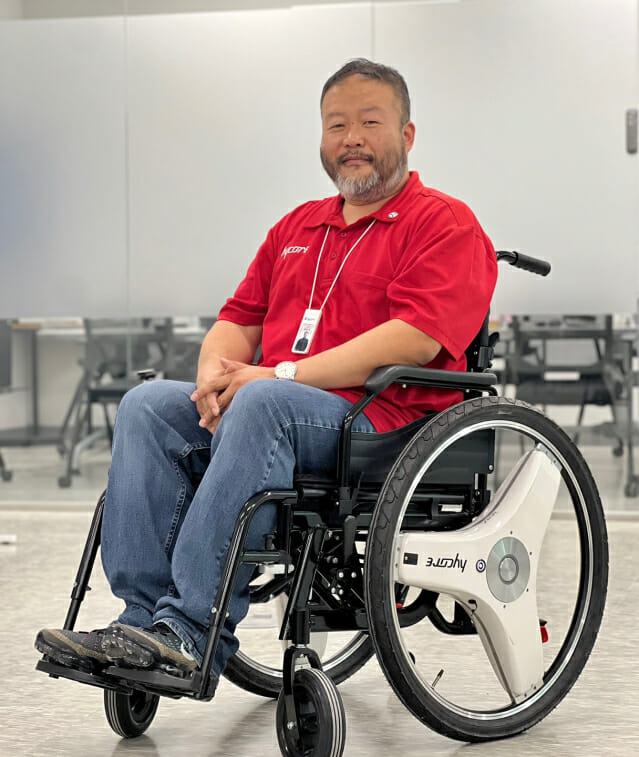 Park Dong-hyun, CEO of HYCORE (Photo: ZDNet Korea, Shin Young-bin)
ZDNet Korea, Shin Young-bin Reporter, burger@zdnet.co.kr







"Over 30% of our country's population are people with mobility impairments. As the aging population continues to grow, this percentage will likely increase. I thought a system to help these individuals was necessary, which is why I started working on wheelchair development four years ago."
Park Dong-hyun, CEO of HYCORE, has a deep interest in technologies that assist people with mobility challenges. There is a personal reason for this. He was a prominent judo athlete until the 10th grade, but one day, he suffered an injury during a match and was diagnosed with a Grade 4 disability. As a result, walking for long periods of time is still a challenge for him.
In 2012, Park established HYCORE and began working on motor synthesis technology and propulsion systems. After years of developing fundamental technologies, he began working on creating electric wheelchairs based on this knowledge.
Park Dong-hyun, CEO of HYCORE, seen riding the subway in an electric wheelchair (Photo: HYCORE).
Once the product was developed, the potential for expansion became evident. Based on the self-made hardware, they began incorporating artificial intelligence autonomous driving technology. They formulated a plan to advance the technology and eventually enter the personal mobility market.
Investments from relevant industries followed. HYCORE is collaborating with Hyundai Motor Group on mobility development and has signed a business agreement with Hanjin for the distribution market. Recently, service robot specialist Everybot acquired the company, aiming to diversify its business.
■ "Long-Term Investment in Motor Synthesis and Control Technology"
EO Park outlined three core technologies of HYCORE: synthetic motor control technology, electric drive design and manufacturing, and artificial intelligence-based autonomous driving, explaining that the company holds proprietary intellectual property in these fields.
A synthetic motor refers to combining two or more motors. HYCORE combined two motors—one for power and one for speed—to improve system efficiency, similar to a transmission system.
"When we start, we use the power-type motor. As speed picks up, we gradually start running both motors together. Once the speed reaches its peak, we shut off the power motor and run only the speed motor. This way, the motor gets some rest time, making it easier to manage heat generation."
Park Dong-Hyun, CEO of HYCORE, explains the design of the synthetic motor. (Photo: ZDNet Korea, Shin Young-Bin)
Control, as much as the design, was no easy task. He explained that significant investment was needed to develop the electronics technology to precisely control the complex motors.
As a result, the company created a wheel conversion platform with the shape of a wheel. Two of the three spokes are equipped with motors, while the remaining spoke holds a battery to maintain balance. This design allows it to be attached directly to a bicycle or cart for use.
Inside the HYCORE electric wheelchair wheel (Photo: ZDNet Korea, Shin Young-Bin)
■ "From Electric Wheelchairs to Personal Mobility"
HYCORE developed the smart electric wheelchair "AutoWheel" based on its core technologies. The AutoWheel is notable for its significantly reduced weight compared to other products. It also features the ability to fold, rotate in place, and operate autonomously.
When I personally test-drove the product, I was impressed by its smooth steering and speed control. The in-place rotation makes it convenient for boarding and disembarking from elevators. It is also equipped with forward collision prevention and an automatic brake system, which helps prevent falls and accidents.
HYCORE began supplying electric wheelchairs to Bundang Seoul National University Hospital in 2022. Since then, the company has been expanding its product supply by partnering with Hyundai Motor Group, KT SkyLife, and Ottobock.
The company has also been active in supporting disability sports events. In March, they visited the World Wheelchair Curling Championships held in Gangneung to engage with athletes from around the world, and thanks to an invitation from the Korea Paralympic Committee, HYCORE will be showcasing its products at the upcoming Paralympic Games.
CEO Park shared, "The global electric wheelchair market was valued at about 5 trillion KRW last year, with an expected annual growth rate of 11.5%. As the elderly population grows, demand is expected to increase rapidly in South Korea as well."
HYCORE employees are seen using electric wheelchairs to move around the Louvre Museum in Paris, France. (Photo: HYCORE)
■ "We will supply technology that is essential for people"
HYCORE is also researching alternative applications beyond wheelchairs. They have developed cold chain transportation robots and electric towing carts, and have opened up possibilities for expansion into personal mobility. Starting in November, they will launch a demonstration service for people with mobility impairments at airports in collaboration with Hyundai Motor Company and Incheon International Airport Corporation.
There are high expectations for their collaboration with Everybot, which has become an affiliate. Combining HYCORE's core technology with Everybot's expertise in service robot R&D, they aim to accelerate the development of autonomous personal mobility robots.
CEO Park emphasizes that while dreaming of a better future, "technological advancement should begin by solving the problems that are right in front of us."
"You can't look at the distant future if you haven't even solved the problems that individuals need. I want to grow the company into one that can supply technology needed tomorrow or the day after, not just in the far-off future."
ZDNet Korea, Shin Young-bin Reporter, burger@zdnet.co.kr